AI can spin up a 3D model in seconds. Yet the people who ship games still treat that output as
disposable — fine to prototype with, not safe to ship — because nobody can prove a
generated asset meets a production spec. That gap, in the words of the practitioners themselves, is
exactly what Grain closes: it turns "does this asset meet spec?" into a signed, machine-checkable
verdict you can act on and settle on.
Public statements from working solo / indie game developers and a fresh (2026) survey of the AI-3D landscape. Verbatim where quoted; paraphrased where noted, with timestamps so you can check the source.
SIGNAL 01 · sourcing is the norm
Rafal Obrebski @dogsdreamGames
AAA game designer · 10+ years on large-scale commercial titles
His advice to solo developers: don't be afraid to use assets from various sources. Rather than spending weeks learning every discipline yourself, lean on work made by specialists — most solo developers who succeed with a commercial title source their assets from various places.
What it means: solo and indie devs can't master every discipline, so they source professional-grade assets — and at scale, agents will do that sourcing. Sourced work has to pass a spec before you trust it — exactly the check Grain runs and signs.
SIGNAL 02 · pro output = deterministic systems
advancenine @advancenine
Electrical engineer → programmer → solo gamedev
He shows that studio-quality output, made alone, came from deterministic systems — math-graph texturing (Substance Designer), object pooling, an ECS "hive mind" (Unity DOTS + Burst) — not from manual grind, and not from AI.
What it means: wherever creative production reduces to deterministic systems, it is both agent-automatable and deterministically verifiable — Grain's precondition. The professional trend grows our surface, it doesn't shrink it.
SIGNAL 03 · AI assets are stuck in prototyping
Rafal Obrebski @dogsdreamGames
Same creator as Signal 01 · same walkthrough
He explains that AI-generated 3D assets (e.g. from Meshy) are good for the prototyping phase, not the shipped game — because they lack optimized topology, proper UV unwrapping, and consistent material shaders, so integrating them into production needs extensive manual cleanup. AI content stays a disposable placeholder used to "sell a vision."
What it means — the bullseye: every friction he names is now a shipped Grain predicate, one-for-one — optimized topology → tri_count + manifold, proper UV unwrapping → uv_present, material/texture and file weight → texture_size + file_size, on a valid file → valid_glb. The blocker isn't generation; it's trust that the asset meets spec. Verification flips an AI asset from placeholder → production-ready, and settlement lets it be bought and shipped on that signed verdict.
SIGNAL 04 · generation is solved — yet he still pays for trust
Stefan Vaskevich @stefan_3d_ai
Founder, Top3D.ai
"This stage [high-poly + retopology] is absolutely solved… there is no way someone will convince me that this is not enough 3D model. If that's not enough, just regenerate it in one minute."
On economics: "If that's going to cost me 10 times cheaper to create a game, I'm going to create a game 10 times cheaper… I don't need to spend thousands of dollars to do that 3D environment." And on the trajectory: "Everything that you can automate will be automated."
And in a second video — an actual weekend build — the same Stefan reaches for his wallet, not a generator: a $20 stylized-forest pack and a $50 stylized-water pack, bought because they're optimized, consistent, and ship-ready in a way a fresh generation isn't. In the same breath he predicts the shift to procedural, in-engine 3D — environments synthesized at runtime rather than modeled or bought.
What it means: the creator who calls generation a solved, 10× cheaper commodity still pays for asset packs — so what he's buying isn't the geometry (that's the commodity), it's the trust that it's optimized, consistent, and ship-ready. It's the whole thesis with a price tag on it: when generation is near-free, value moves to the proof the output meets spec — exactly what Grain signs. And as 3D goes procedural, that trust can't ride along inside a purchased pack anymore; it has to become a signed verdict on the synthesized output. Generation getting solved doesn't shrink Grain's surface; it is Grain's surface.
SIGNAL 05 · the field is already reaching for trust + versioning
"We even had a case when a newer version of the tool was less effective than the previous one. This is the signal for the developers… Tracking versions is also good."
His talk's takeaway — "version churn beats brand consolidation; tool choice needs version-level granularity" — is exactly why Top3D.ai runs as a blind arena: you don't see the tool's name, you just compare and vote.
What it means: the field is already improvising the trust layer — tracking tool versions, running blind quality votes. Grain makes that per-deliverable and machine-actionable: a signed verdict says this exact asset, from whatever tool or version, meets this exact spec — and an agent can settle on it. Tellingly, Top3D.ai's own four arena modes — Geometry, Low-Poly, Segmentation, Textured/PBR — map almost one-to-one onto Grain acceptance profiles: subjective ELO on top, objective signed pass/fail underneath.
SIGNAL 06 · generation without a constraint over-iterates
Guillaume Borgomano Moment Factory
Senior Multimedia Director & Innovation Creative Lead · Moment Factory
"With any GenAI tool, it's easy to over-iterate, to believe the best result is always one click away. Imposing real production constraints, whether financial or time-based, was essential to ensure these explorations remained meaningful and truly impacted our pipelines."
Borgomano is describing a node-based generative pipeline driving large-scale projection mapping — the process made fully malleable. Yet what made it production-meaningful wasn't more nodes; it was a constraint — and he had to impose it by hand, in money and time.
What it means: node-based tools solved the process — the pipeline is editable, re-authorable, infinite. What they leave to the human is the acceptance bar: the production constraint that says stop, this is good enough to ship. A senior practitioner of the best generation tooling names that bar as the essential ingredient — and improvises it manually. Grain makes it a deterministic, signed, settleable verdict: not "is it one click better," but "does this exact output meet this exact spec — yes/no, signed." The generator is the gas pedal; Grain is the brake and the finish line. When generation is infinite, value moves to the constraint that makes it converge.
And the field already builds modularly: devs isolate each system — RPG balance, economy, combat scaling — and data-test it in a sandbox before reintegration (one creator's advice, ~21:36). That's exactly why verified, swappable components compose: when each piece carries a signed verdict that it meets spec, you can trust it to behave when it's combined.
02 The prototype-to-production gap Settlement
Verification is the bridge that's missing.
Generation and shipping are both solved. The gap between them — proving a generated asset is actually production-ready — is where AI 3D stalls today. That gap is a verification problem, and the frictions the field names are now the exact checks Grain runs.
CHEAP & FAST
Generate
Any tool: Meshy, Rodin, Tripo, a human author.
→
THE MISSING STEP
Verify & settle
The named frictions, as predicates: tri_count · manifold · uv_present · texture_size · file_size · valid_glb → signed verdict → release / refund.
→
PRODUCTION
Ship
An asset you can trust, own, and pay for — not a placeholder.
The friction the creator names is now our checklist: topology, UVs, materials and file budgets are deterministic predicates, not opinions. This is the blue-ocean wedge — validators check files but don't settle; payment rails settle but don't check the deliverable. Grain is the weld, and the field is already telling us it's needed.
03 Mindset · the risk zone Spec
Routine gets automated. Taste doesn't.
Stefan's two-bucket test for AI 3D: where your work sits decides whether automation replaces it. The catch — the automatable half still has to be verified before anyone ships it. That half is, almost line-for-line, Grain's checklist.
The pure labor is going to be automated very soon. The judgment-heavy parts — not even close. Move toward Taste. Notice the entire Routine column is what Grain machine-checks (tri_count · manifold · uv_present · texture_size · file_size · valid_glb): Grain verifies the routine so it's shippable; humans keep the taste.
And even inside "Routine," the pipeline still breaks: there's no reliable automated baking that matches a manual artist yet, and rigging (weight-painting, bone placement) is the safest human zone — AAA work still needs an expert to fix and sign off. That's the human-in-the-loop crevice Grain serves: verify what the AI got right, flag what needs a human, and settle fairly between the model provider and the human who polished it. (Same on the frontier — 3D Gaussian splats look stunning but are hard to collide in an engine; "is it actually production-ready?" is always a verification question.)
04 The second trust gap Provenance
An asset can pass spec and still not be yours to ship — and Grain does not judge that yet.
The five signals above argue one axis — does the asset meet a production spec. There is a second axis underneath every transaction — is it clean, and is it yours to ship — and today nothing in Grain's verifier judges it. A solo dev just lived the whole arc in public, and it shows why the trust rail has to grow toward provenance (roadmap) and why settlement has to be reversible (shipped).
Market evidence · provenance
Cakez@Cakez77
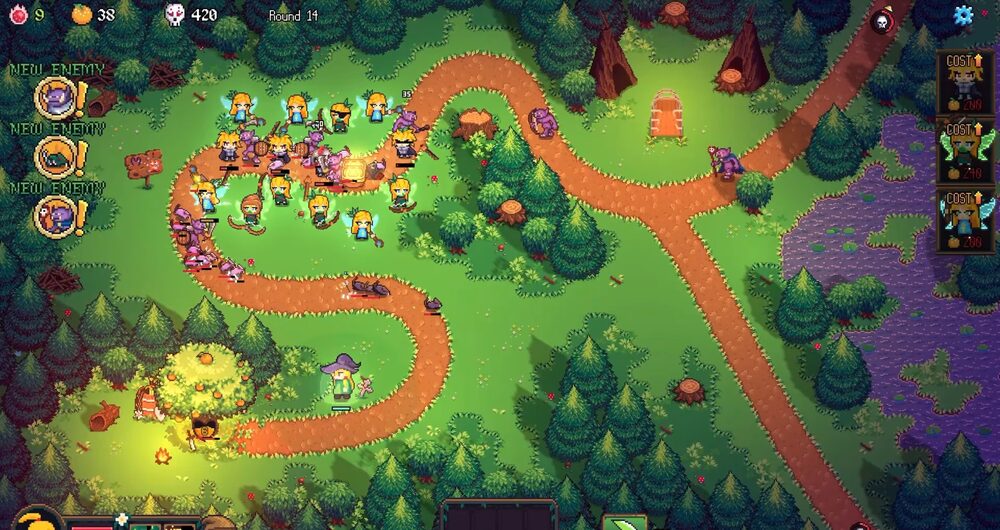
Solo developer · Tangy TD, a tower-defense game he built largely solo over several years, per the interview
He pulled a goblin from a Google image search, changed it just a little, and shipped it inside a game that went viral — then a DMCA strike pulled the whole thing off Steam.
Tangy TD — Cakez's solo-built tower defense, viral at launch. One enemy sprite, pulled from an image search, later drew the DMCA strike that took it off Steam.
The launch was the dream: an emotional reaction clip that spread across the timeline, and a launch that, by his own account, sold strongly in its first week. Then the takedown landed. The claim traced to a single sprite — a goblin Cakez has acknowledged taking from a search result and only lightly editing. The store page went dark until the claim was resolved and the game was reinstated; Tangy TD is back up now. The lesson is not that he was careless; it is that one asset of unprovable origin was a latent liability sitting inside an otherwise finished, profitable product — and nothing in the pipeline surfaced it until a delisting did.
What it means. This is the second thing "trust" has to cover. The first is spec — tri_count, manifold, uv_present, texture_size, file_size, valid_glb — and that half is shipped. The second is provenance — is the asset clean, whose IP is it, where do the royalties flow — and Grain does not judge it today; it is Pillar III on the roadmap (on-chain receipt, royalty trail, creators own their IP). We will say it plainly, because the whole point of this page is proof, not vibes: provenance is on Grain's roadmap, not built. Grain does not today detect copied art, visual similarity, or IP cleanliness. It would not have caught the goblin.
What the story argues for is the part that is shipped: escrowed, reversible settlement. Today Grain signs one canonical verdict and settles it inside a custody boundary where the signing key can never pay itself — release to the seller on pass, refund the buyer on fail. When a sourced asset later proves unclean, that is exactly the machinery the agent economy needs — money that can reverse and a receipt that shows who owned what — instead of a delisted game and a resolution worked out off-platform. At agent scale, where agents source and buy assets autonomously and at volume, an asset of unprovable origin is a liability in every transaction it touches. A trust rail has to carry provenance, and until it judges origin it must at least be able to settle reversibly on the day origin goes wrong.
◆ Built for the way solo devs already work
See the verdict, then settle on it.
Grain grades any asset, from any tool, against a spec you control — and, in the agent economy, settles on the result with no human in the loop.
On sources. The signals above are attributed quotes and paraphrases from publicly published
creator videos, used as commentary. Signals 01–03 are attributed paraphrases; Signals 04–05 are
verbatim quotes (with brief paraphrased context). Each carries a creator/title attribution and a
timestamp so the original can be located and verified — proof, not vibes.
Grain runs on public testnets today — no mainnet, no real funds. This page presents market evidence and a working demo, not financial advice. Built on Minds by Animoca Brands (beta).